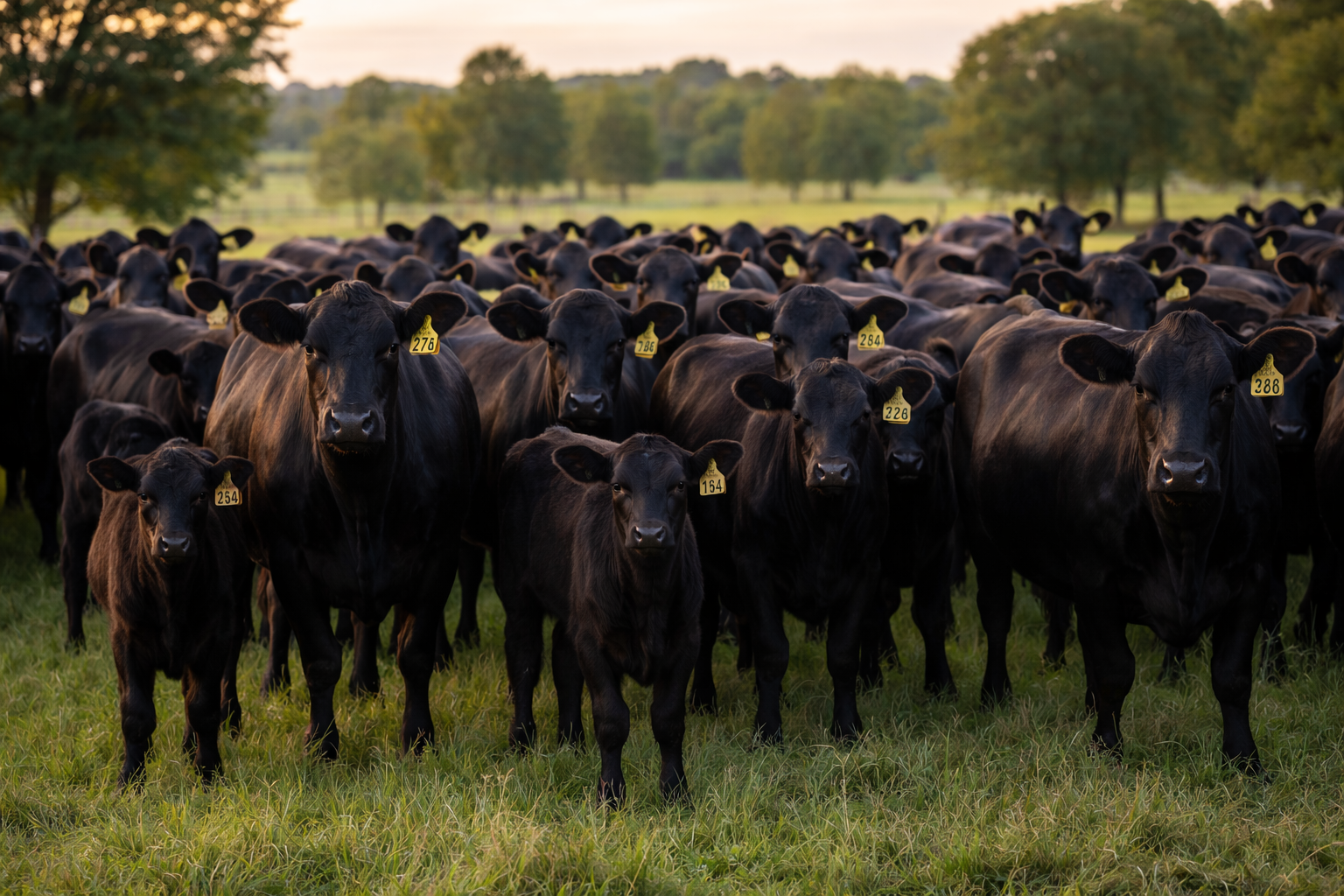
In Issue 1, we explored why cow efficiency — not cow size alone — drives kg/ha, and why a big cow needs to produce a proportionally big calf to earn her keep. Now we take that further: if efficiency matters more than raw EBVs, why do so many high-performing Angus genetics still leave profit on the table in regenerative systems?
At major Angus weaner and yearling sales across eastern Australia, the signals are unmistakable. Top pens of black-hided steers. Recognised seedstock breeders. Sires from elite AI bulls. High EBVs and leading $Indexes. Strong competition and rising prices. Confidence builds quickly. These must be the right Angus.
And often, they are — for a particular system.
But as more producers shift toward regenerative, pasture-based production to build soil health, resilience, and grass-finished margins, a different pattern is emerging.
Months later, in many of these systems, the outcome tells a very different story.
When Expectations Don’t Match Reality
Producers take those cattle home and commit fully to regenerative principles:
- ✓ Structured grazing to stimulate pasture recovery
- ✓ Extended rest periods for root development and soil biology
- ✓ Minimal supplementation to let biology drive production
- ✓ Focus on kilograms of beef per hectare from regenerated pastures
But instead of strong performance:
- Frame continues to stretch ahead of finish
- Condition stalls during seasonal pressure
- Finishing slows on variable pasture quality
- Time to market extends
Margins tighten as the low-input promise gets offset by longer holding periods.
And eventually, the familiar comment is heard in the yards:
“I thought those steers would’ve done better under your management.”
The Problem Started Earlier
At that point it’s easy to question season, pasture, or grazing execution.
But in many cases: the mismatch started before the cattle ever left the sale yard.
The Industry Signals
At sale time, buyers are influenced by:
Breeder Reputation
Recognised studs with established names and show ring success.
Sire Performance
Elite AI bulls with high-performance progeny records.
EBVs & $Indexes
Strong genetic metrics across growth, carcase, and reproduction traits.
Visual Power
Frame, muscle, and structural presence in the sale ring.
These are strong signals in the Angus industry.
But they reflect performance optimised in one type of system — not every system, especially not the variable, biology-driven regenerative ones many are now adopting.
The Regenerative System Reality
Regenerative systems operate differently.
They rely on:
- ✓ Variable pasture quality across seasons
- ✓ Soil biology and nutrient cycling to drive output
- ✓ Recovery-driven grazing to build microbial activity and organic matter
- ✓ Low-input, efficiency-focused production
And critically: they depend on a functioning biological system underground to make everything above ground work consistently.
Biology Before Grazing
One of the biggest misconceptions in regenerative grazing is that higher density, more frequent rotations, and longer rest will automatically lift production.
But in practice:
“You can’t manage or graze your way out of a broken biological system.”
If soils are mineral deficient, low in microbial activity, lacking structure, or depleted in organic matter, pasture response remains limited — no matter how well you time the graze or extend the rest.
The soil biology — the bacteria, fungi, and life in the soil — has to be active and functioning to cycle nutrients, build root exudates, improve water infiltration, and enable quick recovery. Without it, rest periods often turn into extended dormancy rather than accelerated growth, capping the entire system.
The Angus Mismatch in Regenerative Systems
Many high-selling Angus lines today have been selected for high post-weaning growth, larger mature frame, and feedlot efficiency/carcase weight.
They perform extremely well when supported by consistent high-energy nutrition and controlled feeding.
But in regenerative systems — where energy supply is variable, feed quality fluctuates seasonally, and true efficiency on diverse, biology-built pastures matters more than maximum growth — the equation shifts quickly.
What Actually Happens
Instead of efficient conversion to grass-finished beef:
- Frame grows ahead of finish
- Maintenance requirements increase
- Energy diverts away from fat deposition toward skeletal growth
- Time to finish extends
The system’s biological engine can’t keep pace with the genetic demand, even with solid grazing management.
Where the Profit Shifts
Eventually, many of these cattle are sold into feedlots or controlled finishing systems.
And suddenly: performance improves, weight comes on, cattle hit specifications quickly.
Because now they are in the system they were bred for.
The Hard Reality
The feedlot doesn’t create extra value — it captures what the earlier regenerative system couldn’t realise due to the mismatch.
The Key Principle
Good cattle in the wrong system become poor performers.
The profit wasn’t lost during production.
It was lost at the buying decision.
Connecting the System
This brings the whole system together:
Soil biology drives pasture production and recovery. Pasture drives carrying capacity and feed base. Cow type determines maintenance cost. Genetics must align with all of it.
Why BeefAI™ Exists
This is exactly why BeefAI™ was built.
Because the challenge isn’t finding good Angus, following grazing systems, or adopting regenerative practices.
It’s understanding how genetics, biology, pasture, and environment interact in real regenerative operations — and optimising them together for long-term sustainability and profit.
BeefAI™ is a genetic optimisation platform that finds the right bulls for your system — accounting for biology, environment, and pasture reality, not just the sale catalogue:
Genetic Optimisation — Built for Real Production Systems
Cow Size & Maintenance
Evaluates cow size and maintenance requirements in variable pasture systems — not just under ideal conditions.
Feed Efficiency
True grass conversion efficiency, not feedlot gain. How well genetics perform on biology-built pastures.
Environmental Fit
Production system and environmental fit modelling — matching genetics to real country, not theoretical conditions.
kg/ha, Not kg/Head
Every bull ranking is oriented toward kilograms of beef per hectare — because profit is made per hectare, not per head. The right genetics utilise your pastures more efficiently.
Instead of asking “Which Angus is best?”
It asks: “Which Angus actually works and profits in your regenerative system — and how do we align the whole farm biology to make it thrive?”
The Shift That Matters
The next phase of the beef industry — particularly regenerative — won’t come from chasing higher EBVs, buying the top pen, or following grazing trends alone.
It will come from making decisions aligned with real biological systems: diagnose constraints, build the soil engine, then let grazing and genetics amplify it for resilient, profitable production over decades.
Final Thought
The most profitable regenerative producers don’t chase sale-day signals.
They understand their system first — starting with what’s happening in the soil.
They select cattle that fit their country, match their regenerating pasture, align with their biology, and perform under real conditions.
Because in the end: profit doesn’t come from buying the best cattle.
It comes from buying the right cattle for a system where biology is working — and optimising the entire farm around that biology for long-term sustainability and profit.
The profit was never in the cattle. It was always in the decision — the match between the genetics and the system they run in.
Find Genetics That Fit Your System
Every bull analysed through the lens of whole-farm biology — cow size, efficiency, environmental fit, and kilograms of beef per hectare.
Sign Up Free at BeefAIWant the full picture? Read The AI Stockman — the feature article covering how BeefAI™ transforms Angus bull selection by encoding decades of breeding experience into genetic decision software.