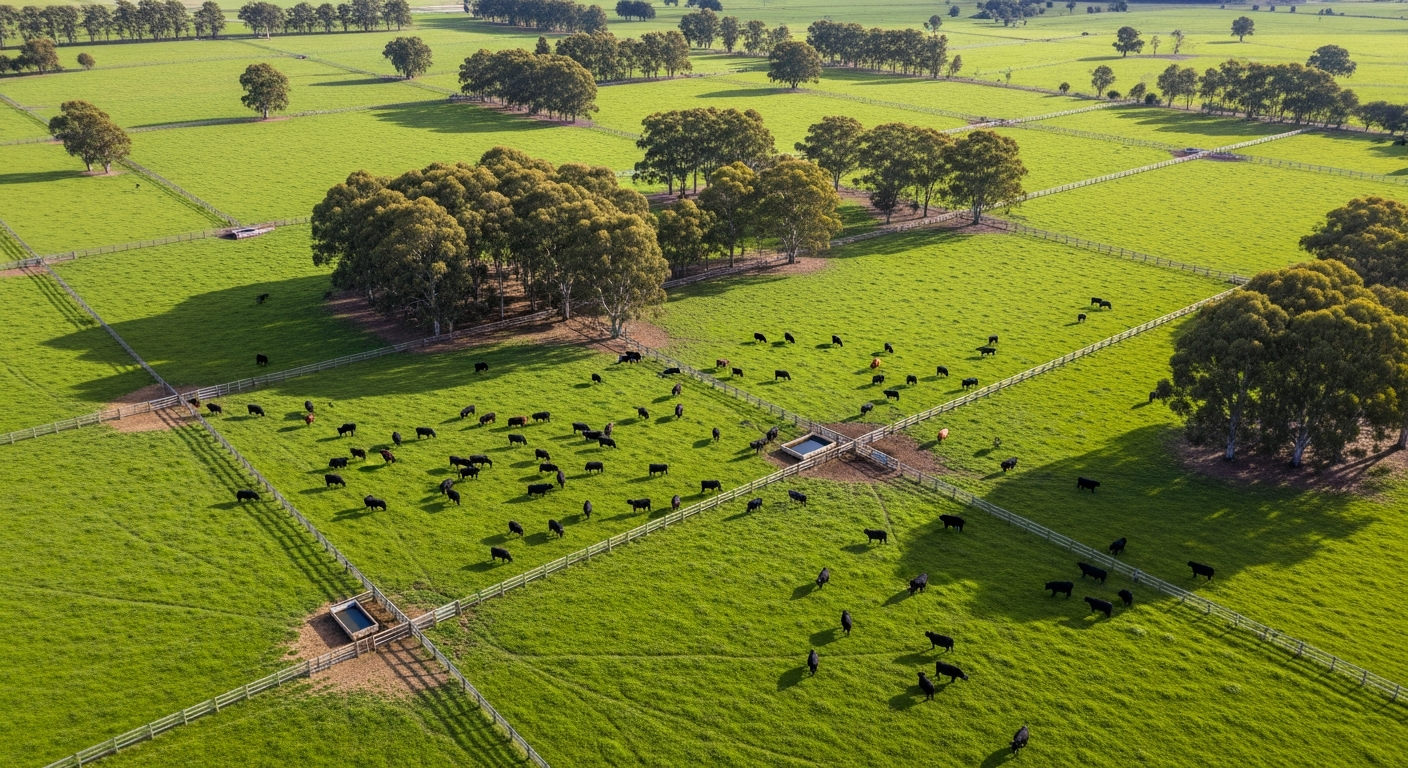
In Issue 1, we showed that cow efficiency — not cow size — drives real kg/ha. In Issue 2, we explained why high-EBV Angus often underperform in regenerative systems when genetics aren’t matched to environment. Now the question shifts: even with the right cattle and the right grazing, why does grass production still plateau?
You’ve done the hard work. You’ve diagnosed your soil biology and started addressing constraints. You’ve selected Angus genetics that fit your country, your pasture base, and your low-maintenance regenerative model. You’ve structured grazing with high density, short graze periods, and extended rest to stimulate recovery and build microbial activity. The system is aligned — or so it seems.
Yet kg/ha still doesn’t climb like it should.
Carrying capacity plateaus. Seasonal slumps hit harder than expected. Pasture biomass production lags, even in good years.
The yards conversation shifts:
“We’ve got the right cattle. Grazing is on point. Why aren’t we growing more grass?”
The answer is simple, but overlooked:
You don’t have a cattle problem. You have a grass production ceiling.
When Alignment Isn’t Enough
Even with fit genetics and solid grazing execution, production is gated by one thing: how much pasture you actually grow per hectare.
In regenerative systems, grass (and diverse forage) is the engine. It supplies the energy for efficient conversion to beef. It determines carrying capacity, finishing speed, and overall kg/ha.
But if that engine is underpowered — if grass production hits a ceiling — the whole system underperforms, no matter how well the cattle or grazing are managed.
The Grass Production Reality
Regenerative producers often assume that once biology improves and grazing is optimised, pasture will respond dramatically.
In practice, it doesn’t always happen that way.
Many systems hit a ceiling because:
- Pasture growth is still limited by seasonal variability — dry spells, low winter activity
- Biomass accumulation is inconsistent due to incomplete soil function
- Diversity is low, leading to narrow nutrient windows and slower recovery
- Root systems remain shallow, reducing access to deeper moisture and minerals
The result: even good grazing redistributes pressure across a limited feed base, rather than expanding it.
Biology Drives the Grass Engine — Feed the Soil First
Grass doesn’t grow from grazing. Grazing only manages it. Grass grows from soil biology — and biology only responds when it’s fed.
The soil food web (bacteria, fungi, protozoa, earthworms) must actively cycle nutrients, solubilise locked-up minerals, and support root exudates that feed microbes in return.
This liquid carbon pathway is the primary way plants feed the soil:
- ✓ It fuels microbial growth and activity, creating a symbiotic loop: microbes mineralise nutrients back to plants in plant-available forms
- ✓ It builds stable soil organic matter far more effectively than surface residue incorporation
- ✓ It drives fungal networks (mycorrhizae) for extended nutrient and water access and aggregation for better structure
When biology is vibrant
- Roots deepen and branch extensively, pumping more exudates
- Nutrient release accelerates during rest periods
- Water infiltration and holding capacity improve dramatically
- Forage quality rises from better mineral availability
- Biomass production increases steadily — often dramatically
When biology is constrained
- Slower regrowth after graze
- More dormancy than acceleration during rest
- Seasonal slumps drag out finishing times
- Lower overall kg/ha despite aligned cattle
- Grass production stays capped regardless of management
Diversity, Exudates, and Grazing Strategy
Consistent “take-half, leave-half” grazing can inadvertently favour grasses (which recover quickly via root reserves but send only ~5% of photosynthate as exudates) over forbs (which allocate up to 35% to exudates — the real builders of stable carbon and microbial diversity).
Grasses vs Forbs — The Carbon Story
Grasses cycle carbon quickly (bacterial-dominated, short-lived). They recover fast but contribute relatively little to long-term soil building.
Forbs feed fungi more effectively with complex exudates (fatty acids, amino acids from mature plants), building long-term soil organic matter and fungal networks that enhance resilience and nutrient cycling.
In Australian regenerative Angus systems, this means periodically incorporating harder grazing resets — graze grasses closer to the ground in strategic windows — to reduce grass dominance, encourage forb re-establishment, and boost diverse root exudates. This feeds the soil biology more robustly, shifting from fast bacterial cycles to fungal-driven stable carbon and deeper soil function.
Without feeding the soil this way — through diverse, high-exudate plants and intentional disturbance — grass biomass and quality remain limited, even in well-managed regen setups.
The Common Bottlenecks in Australian Systems
In eastern Australia’s variable rainfall and often depleted soils, common grass limiters include:
- Low organic matter and structure — poor water retention and aeration
- Imbalanced minerals (calcium for structure, phosphorus for energy transfer) limiting microbial and plant function
- Dominance of grasses over forbs — faster carbon cycling but less stable soil organic matter buildup
- Incomplete recovery cycles — roots don’t pump enough liquid carbon to build fungal networks
These aren’t fixed by more grazing intensity alone — they require targeted biological support: mineral corrections, microbial stimulation, diverse forage mixes, and strategic resets to maximise exudates and long-term fertility.
What Happens When Grass Is the Bottleneck
Even moderate-frame, efficient Angus struggle:
- They convert what grass is available well — but there’s simply less available
- Maintenance demands stay low, but output per head/ha doesn’t scale
- Finishing extends, margins compress, and regen premiums get harder to capture consistently
“Every extra tonne of dry matter you don’t grow per hectare is lost carrying capacity, delayed finishing, and unrealised kilograms of beef you can never recover.”
The cattle aren’t the issue. The grass engine is — and it’s underfed at the soil level.
The Hard Reality
You can buy the right Angus, implement perfect grazing, and still leave profit on the table if grass production doesn’t expand.
The feed base sets the ceiling — powered by soil biology. But what sits on top of that feed base matters just as much. Genetics that don’t match the system demand more from a limited pasture, compressing carrying capacity and compounding the problem with every generation. Getting the match right is how you make every blade of grass work harder.
The Genetic Link
As established in Issue 2, soil biology drives everything above it in the chain — grass production, carrying capacity, cow efficiency, and finally genetics. But the relationship runs in both directions. Genetics influence every link in that chain. Mismatched genetics demand more from a limited feed base, compress carrying capacity, lower cow efficiency, and put pressure on the soil biology below. Well-matched genetics amplify every step above them.
Why BeefAI™ Exists
This is precisely why BeefAI™ was built.
Because understanding the grass engine isn’t optional — it’s essential for making the right genetic decisions. And mismatched genetics compound. Every bull you use imprints on your herd for generations. Big, growthy cattle absolutely perform in the right system — many leading studs prove that every year. But choose genetics whose demands don’t match your carrying capacity, your feed base, or your soil’s actual output — and no grazing plan will fix it. The mismatch embeds deeper with every mating cycle.
BeefAI™ evaluates every bull against the biological reality of the system it will run in — not just against the sale catalogue. The CER (Carbon Efficiency Ratio) engine flags when a bull’s genetic demand profile exceeds what the grass engine can support. If the genetics don’t fit the system, no rotation fixes it.
Genetic Optimisation Within the Biological Framework
Right Genetics, Right System
Genetic decisions are made within the context of your whole farm — soil, pasture, environment — not just the cattle in front of you.
Wrong Genetics Compound
A bull that doesn’t fit your system today produces daughters that won’t fit it for the next decade. The cost isn’t this season — it’s every season after.
Feed Base Fit
Cow efficiency and genetic fit are evaluated against realistic feed base potential — because the best genetics in the world can’t overcome a capped pasture.
kg/ha, Not kg/Head
Every ranking and recommendation is oriented toward kilograms of beef per hectare — the metric that actually drives profitability.
Even the best grazing plan cannot compensate for genetics that don’t match the land. You can rotate perfectly, rest adequately, and manage stocking rates with precision — but if the cattle are too big, too high-maintenance, or genetically misaligned with your feed base, the system underperforms and the problem deepens with every generation.
The deeper question is: “Are my genetics aligned to the biological reality of this land — or am I breeding my way into a problem that no grazing plan can fix?”
The Shift That Matters
The next leap in regenerative Angus beef won’t come from better bulls, stricter rotations, or more rest alone.
It will come from recognising grass as the engine — and optimising the soil biology that powers it by prioritising liquid carbon feeding from plants.
Diagnose the real limiters. Feed the soil biology robustly. Then let aligned cattle and grazing amplify it for decades of sustainability and profit.
Final Thought
The most profitable regenerative producers don’t blame the cattle or the grazing when kg/ha stalls.
They look at the grass first — what’s actually growing per hectare, and why.
They understand that cattle performance, finishing speed, and margins all flow from a high-functioning grass engine, powered by vibrant soil biology that’s continually fed through root exudates and liquid carbon.
A paddock can be perfectly grazed and still underperform if root systems are shallow, fungal networks are weak, and exudate flow is limited. It will look “managed” — but it won’t produce.
Because in the end: you unlock more kg/ha from two directions — growing more grass from healthy soil biology, and choosing genetics that utilise every kilogram of that grass more efficiently.
Same land. Lower inputs. Higher total output.
Find the Bulls That Fit Your System
Every analysis matches genetics to your biological reality — because the right bull makes your pastures more productive, and a mismatched one caps them.
Sign Up Free at BeefAIWant the full picture? Read The AI Stockman — the feature article covering how BeefAI™ transforms Angus bull selection by encoding decades of breeding experience into genetic decision software.